
 EN
EN ES
ES PT
PT TH
TH VN
VN JP
JPConstruction equipment is not managed like a regular delivery fleet.
An excavator may sit on one job site for three weeks. A generator may move between sites without a dedicated driver. A trailer may be parked overnight in an open yard. A rental machine may be used by different operators, in different locations, with limited visibility after delivery.
That is why choosing a GPS tracker for construction equipment is not just about real-time location. The right device should match the asset type, power condition, installation environment, reporting frequency, theft risk, and maintenance schedule.
This guide walks through what to check before buying a construction equipment GPS tracker and how to choose the right tracking device for different machines, from excavators and loaders to trailers, generators, and mixed construction fleets.
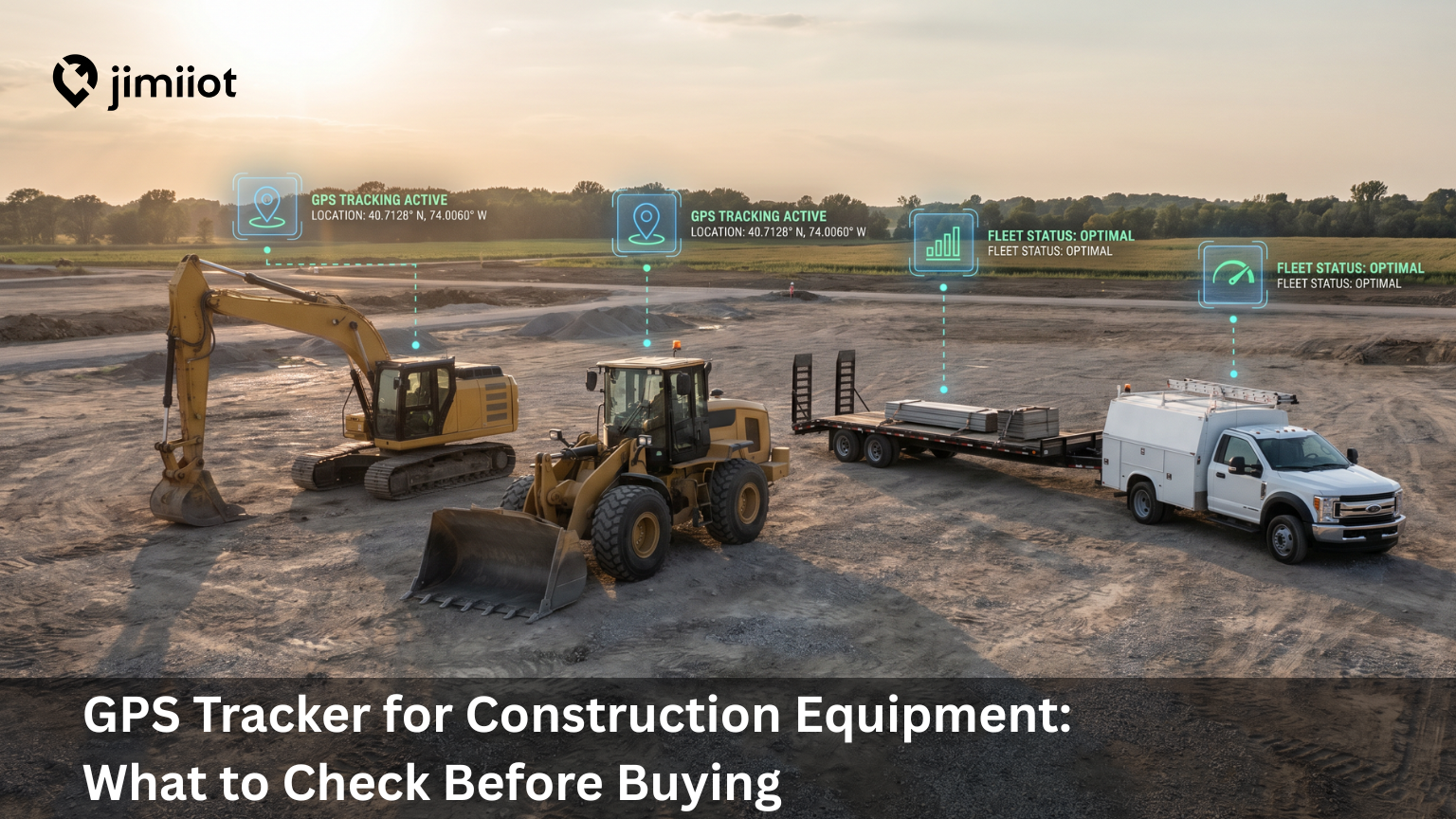
Why Construction Equipment Needs a Different Tracking Approach
Many fleet trackers are designed for cars, vans, or trucks. Construction equipment is different.
Heavy equipment often operates in harsh outdoor environments, stays idle for long periods, moves between temporary job sites, and may not always have an accessible OBD port or stable power source. Some assets are powered, while others are completely unpowered, such as trailers, containers, attachments, or portable generators.
Construction sites also involve safety, dispatch, utilization, and theft concerns. OSHA notes that struck-by hazards are a major construction risk, and approximately 75% of struck-by fatalities involve heavy equipment such as trucks or cranes. Better visibility into equipment location and movement can support safer site coordination, although it should never replace proper safety procedures, training, and traffic control.
For theft prevention, construction companies may also use external resources such as the National Equipment Register, which provides heavy equipment databases and recovery-related services for owners, insurers, and law enforcement.
A practical construction equipment tracking system should help answer questions like:
- Where is each machine right now?
- Has the asset entered or left the job site?
- Is the equipment being moved after hours?
- Is the tracker being removed or tampered with?
- How long has the machine been operating or sitting idle?
- Which equipment is available for the next job?
- Which assets need battery charging, inspection, or maintenance?
Quick Buying Checklist
Before choosing a GPS tracker, start with the asset itself.
| What to Check | Why It Matters | What to Look For |
|---|---|---|
| Asset type | Excavators, trailers, generators, and service trucks need different tracking setups | Match the tracker to powered, unpowered, mobile, or stationary assets |
| Power source | Some machines have a stable battery, while others do not | Choose wired, rechargeable, replaceable-battery, or solar-assisted trackers |
| Installation method | Construction assets may not allow complex wiring | Magnetic mount, screw-fixed base, hidden installation, or wired connection |
| Battery life | Long idle periods can drain the tracker if reporting is too frequent | Multiple working modes, low-power mode, solar charging, or replaceable batteries |
| Durability | Equipment is exposed to dust, rain, vibration, and impact | IP-rated housing, rugged design, wide operating temperature |
| Network coverage | Job sites may be outside dense urban areas | 4G LTE, LTE-M, NB-IoT, GSM fallback, and regional band compatibility |
| Location accuracy | Dispatch and recovery depend on reliable positioning | GPS/LBS, GPS/BDS/LBS, or multi-source positioning |
| Alerts | The value comes from events, not just dots on a map | Geofence, vibration, movement, tamper, low battery, removal alerts |
| Platform | Managers need usable reports, not raw data | Web dashboard, mobile app, route history, utilization reports |
| Integration | Larger fleets may use mixed equipment systems | API support, exportable data, or telematics data workflows |
| Maintenance cost | A cheap tracker can become expensive if it needs frequent servicing | Long standby, easy charging, Bluetooth configuration, simple redeployment |
1. Check Whether the Equipment Is Powered or Unpowered
This is the first question.
A GPS tracker for a powered excavator may use the machine’s power source. A tracker for a trailer, container, attachment, or portable generator may need its own battery. A rental fleet may need something easy to install and remove, while owned heavy machinery may justify a more permanent setup.
Powered Equipment
Examples:
- Excavators
- Bulldozers
- Loaders
- Cranes
- Dump trucks
- Concrete mixers
- Construction service vehicles
For powered equipment, you can consider a wired GPS tracker if you need ignition detection, remote cut-off, driver identification, fuel monitoring, or deeper fleet management features.
For example, the Jimi IoT JM-VL02 is designed for industrial and commercial fleet applications, including construction equipment. It supports ACC detection, remote fuel/power cutoff, SOS button, and multiple I/O options for peripherals.
Unpowered or Hard-to-Wire Assets
Examples:
- Trailers
- Containers
- Portable generators
- Compressors
- Light towers
- Attachments
- Temporary storage units
For these assets, a battery-powered tracker is often more practical. Look for long standby time, vibration alerts, tamper detection, and flexible mounting.
The Jimi IoT LL302, for example, is a 4G wireless asset GNSS tracker designed for vehicle and asset tracking. It supports GPS/LBS positioning, light sensor tamper alerts, abnormal vibration alerts, low battery alerts, and a strong magnetic base for near-zero installation.
2. Match Battery Life to Reporting Frequency
Battery life is one of the most misunderstood parts of construction equipment tracking.
A tracker that reports every few seconds will consume more power. A tracker that reports once or twice per day can last much longer. For some assets, daily location updates are enough. For high-value machines or rental equipment, you may want more frequent updates and event-based alerts.
Ask these questions before buying:
| Question | Why It Matters |
|---|---|
| Do I need real-time tracking or periodic location updates? | Real-time tracking uses more battery |
| Does the equipment move every day or only occasionally? | Idle assets can use low-power modes |
| Is solar charging possible? | Solar can reduce manual charging work |
| Can the battery be replaced in the field? | Useful for long-term non-real-time tracking |
| Can reporting modes be configured? | Different assets need different update intervals |
For solar-assisted deployments, the Jimi IoT LL303Pro is a strong fit. It is a 4G solar-powered GPS tracker designed for construction vehicles and vessels, with solar charging, magnetic charging, IP67 dust and water resistance, multiple working modes, event-triggered alerts, and optional Bluetooth accessories.
For long-standby non-real-time tracking, the Jimi IoT LL701 supports replaceable CR123A batteries, IP67 protection, movement detection, tamper alerts, and standby time up to 5 years depending on reporting frequency.
3. Choose the Right Installation Method
Construction equipment is often exposed, dirty, and difficult to wire. Installation time matters, especially if you manage many assets across job sites.
Common installation options include:
| Installation Type | Best For | Notes |
|---|---|---|
| Magnetic mount | Trailers, containers, generators, rental assets | Fast to deploy, easy to move |
| Screw-fixed installation | High-value machinery, long-term deployment | More secure, better for permanent use |
| Wired installation | Powered machines and fleet vehicles | Enables ignition, cut-off, fuel, and I/O features |
| Hidden installation | Theft-sensitive equipment | Helps prevent removal or tampering |
| Solar-assisted installation | Outdoor assets with limited charging access | Reduces maintenance pressure |
The Jimi IoT Outdoor Engineering Asset Management Solution highlights common construction challenges such as inaccurate dispatch, difficulty calculating working hours, and difficult installation or maintenance. Its LL303-based solution supports magnetic or screw-fixed bases, solar power, waterproof and shock-resistant design, Bluetooth sensors, operational hour calculation, and geofencing.
4. Check Ruggedness for Outdoor Conditions
Construction equipment trackers should be built for real working environments, not clean indoor conditions.
Look for:
- Water resistance
- Dust resistance
- Vibration resistance
- Shock-resistant housing
- Wide operating temperature range
- Secure mounting
- Tamper detection
- Reliable charging or battery access
For example, the LL303Pro has IP67 dust and water resistance and is designed for tough outdoor conditions. The JM-LL02 also features IP67 dust and water resistance, a 6,000 mAh battery, strong magnetic mount, magnetic charging, Bluetooth configuration, and tamper alerts.
For assets exposed to rain, mud, and outdoor storage, IP-rated trackers are usually a better choice than basic consumer GPS devices.
5. Do Not Buy Based on Location Only
Location is important, but it is only the beginning.
A useful construction equipment tracking system should also provide event-based visibility. Instead of checking the map all day, managers should receive alerts when something important happens.
Important alert types include:
| Alert Type | Use Case |
|---|---|
| Geofence entry/exit | Know when equipment enters or leaves a job site |
| Vibration alert | Detect abnormal movement or possible theft |
| Movement alert | Know when an idle asset starts moving |
| Tamper/removal alert | Detect tracker removal |
| Low battery alert | Schedule charging or replacement |
| Door status alert | Monitor containers or enclosed equipment |
| Ignition/ACC alert | Track engine status on powered machines |
| Fuel/power cut-off alert | Support anti-theft control for selected wired installations |
The JM-VL02 supports multiple alerts such as impounding, geofence entry/exit, abnormal vibration, and speeding, along with ignition detection and optional peripherals for fuel or temperature monitoring.
6. Think About Utilization, Not Just Theft
Many companies start looking for a GPS tracker because they are worried about theft. But after deployment, one of the biggest long-term benefits is utilization visibility.
Construction equipment is expensive. If a machine is sitting idle on one site while another site is waiting for equipment, the company loses time and money.
A GPS tracking system can help managers:
- See which equipment is available
- Avoid unnecessary rentals
- Reduce idle assets
- Improve dispatch planning
- Track arrival and departure at job sites
- Compare asset usage across projects
- Support rental billing with working-hour data
- Plan maintenance based on actual use
For rental companies, usage data is especially important. Jimi IoT’s construction machinery solution points out that without a tracker, service providers may find it difficult to accurately track operational and idle time for billing.
7. Consider Data Standards and Platform Integration
If you manage a small equipment fleet, a web dashboard and mobile app may be enough.
If you manage a larger mixed fleet, you may need to think about data exchange and integration. For example, the AEM page for ISO/TS 15143-3: ISO Fleet Data Exchange explains that the standard specifies a communication schema for providing mobile machinery status data from a telematics provider’s server to customer applications.
Before choosing a GPS tracking solution, ask:
- Can I export data?
- Can the platform support multiple asset types?
- Can the system work with different trackers?
- Can reports be shared with operations, dispatch, or maintenance teams?
- Does the vendor support API or SaaS integration if needed?
- Can I manage equipment, vehicles, and assets in one platform?
This matters because construction fleets are rarely simple. One company may need to track excavators, trailers, service trucks, generators, fuel tanks, and materials at the same time.
Recommended Jimi IoT GPS Trackers for Construction Equipment
Different construction assets need different tracking devices. Here are several Jimi IoT options to consider.
| Recommended Device | Best For | Why It Fits |
|---|---|---|
| LL303Pro Solar Powered GPS Tracker | Construction vehicles, outdoor machinery, vessels, long-term outdoor assets | Solar and magnetic charging, IP67 protection, multiple working modes, event-triggered alerts, optional Bluetooth accessories, and support for construction machinery management scenarios. (Jimi IoT) |
| LL701 Long-Standby Asset Tracker | Heavy-duty assets, trailers, goods, non-real-time tracking | Replaceable CR123A battery, IP67 rating, tamper alert, movement detection, and up to 5 years standby depending on reporting frequency. (Jimi IoT) |
| LL302 4G LTE Cat 1 Asset GNSS Tracker | Rental equipment, trailers, containers, mobile assets | GPS/LBS positioning, 6,000 mAh battery, strong magnetic base, tamper alert, vibration alert, multiple working modes, and up to 300 days standby in power-saving mode. (Jimi IoT) |
| JM-LL02 Asset GNSS Tracker | Rugged asset tracking with simple deployment | 6,000 mAh battery, strong magnetic mount, IP67 dust and water resistance, Bluetooth configuration, magnetic charging, and tamper alert. (Jimi IoT) |
| LL301 LTE Cat 1 Asset GNSS Tracker | Long-standby asset tracking and reusable deployment | 10,000 mAh battery, GPS/LBS positioning, strong magnetic base, multiple alerts, multiple working modes, and up to 2 years standby in battery-saving mode. (Jimi IoT) |
| JM-VL02 Fleet Tracker | Powered construction equipment and fleet security | ACC detection, remote fuel/power cut-off, SOS button, optional fuel/temperature sensors, RFID reader, and multiple alerts for industrial and commercial fleet applications. (Jimi IoT) |
| VL103M Vehicle Tracker | Construction service vehicles, trucks, and powered fleet assets | 4G multifunctional vehicle tracker with GPS/LBS positioning, external buzzer/horn support, low voltage alert, multiple alerts, IP66 protection, and 9–90VDC input. (Jimi IoT) |
| VL502 OBDII GNSS Tracker | Service vehicles, pickups, and OBD-compatible construction fleets | Plug-and-play OBDII installation, vehicle data access, fault code, mileage, fuel consumption statistics, engine speed, driving behavior alerts, and geofence alerts. (Jimi IoT) |
Which Tracker Fits Which Construction Asset?
| Asset Type | Recommended Option | Reason |
|---|---|---|
| Excavators and loaders | LL303Pro or JM-VL02 | LL303Pro is better when wiring is difficult; JM-VL02 is better when you need ignition, cut-off, or peripheral integration |
| Bulldozers and cranes | LL303Pro or JM-VL02 | Rugged outdoor deployment and advanced event monitoring |
| Trailers | LL701, LL302, or JM-LL02 | Long standby, movement alerts, tamper alerts, and simple installation |
| Portable generators | LL302, LL301, or JM-LL02 | Battery-powered tracking with vibration and removal alerts |
| Containers and storage units | LL302 or JM-LL02 | Magnetic installation and tamper detection |
| Rental machinery | LL303Pro, LL302, or JM-VL02 | Depends on whether the asset is powered, unpowered, or requires usage-based billing |
| Construction service trucks | VL103M, VL502, or JM-VL02 | Vehicle-focused tracking, OBD data, ignition detection, or remote cut-off options |
| Temperature-sensitive materials or cargo | LL309 | Built-in temperature and humidity monitoring, location records, and real-time condition alerts. (Jimi IoT) |
Final Buying Recommendation
There is no single best GPS tracker for all construction equipment.
For outdoor construction machinery that needs long-term deployment and reduced charging work, choose a solar-assisted tracker like LL303Pro.
For trailers, containers, generators, and assets that do not need real-time second-by-second tracking, choose a long-standby asset tracker like LL701, LL302, JM-LL02, or LL301.
For powered machines where you need ignition detection, remote cut-off, fuel monitoring, or deeper I/O integration, choose a wired tracker like JM-VL02.
For construction service vehicles and OBD-compatible trucks, choose VL103M or VL502 depending on whether you need hardwired installation or plug-and-play OBD data.
The best construction equipment tracking setup is usually a combination of devices, selected by asset type, power condition, and operating scenario.
Need help choosing the right GPS tracker for your construction fleet?
Jimi IoT provides rugged GPS tracking devices for construction equipment, trailers, generators, service vehicles, and mixed fleets. Contact our team to find the right tracking solution for your asset type, installation needs, and operating environment.


